Author: RBox | Category: News & Events
Starting from Q4 2026, Affiliate Marketing activities in Vietnam have entered a phase of tightened tax administration under a new legal framework comprising the Law on Personal Income Tax No. 109/2025/QH15, the Law on E-Commerce No. 122/2025/QH15, Decree No. 68/2026/ND-CP, Decree No. 252/2026/ND-CP, and Official Dispatch No. 7403/CT-TMDT dated October 6, 2026, issued by the Department of Taxation.
The simultaneous overhaul of commission tax withholding mechanisms by major e-commerce platforms like Shopee and TikTok Shop, alongside requirements for partners to verify their revenue, has left many KOLs, KOCs, and individual affiliates confused. The guide below systematically and accurately outlines all the latest regulations to help you remain compliant and avoid the risks of back taxes or payout disruptions.

1. The October 1, 2026 Turning Point: Affiliate Commissions Reclassified as "Business Income"
During the first nine months of 2026, e-commerce platforms such as Shopee generally applied a 10% Personal Income Tax (PIT) withholding rate on affiliate commissions earned by unregistered individuals, treating these payouts as income from salaries and wages.
However, effective October 1, 2026, the legal nature of this tax withholding changed completely:
-
The total withholding rate remains 10%, but it is now split into 5% Value-Added Tax (VAT) + 5% PIT, classified under income from business activities.
-
According to official guidance from the E-Commerce Tax Sub-Department (Department of Taxation) in Official Dispatch No. 7403/CT-TMDT, income is only classified as salaries and wages if the individual signs a labor contract or collective labor agreement under the Labor Code. Conversely, all commissions generated from digital content creation, product promotion, and affiliate link placement on e-commerce or digital platforms are classified as business income, regardless of whether the individual has registered a business or not.
-
Affiliate marketing is categorized under the provision of digital information content services (digital advertising), subject to tax rates of 5% VAT and 5% PIT.
-
Pursuant to Article 43 of Decree No. 252/2026/ND-CP, operators of e-commerce platforms with online ordering and payment functions (such as Shopee and TikTok Shop) are responsible for withholding, declaring, and remitting taxes incurred from individuals' platform activities to the state budget on their behalf.
2. Categorization of Tax Obligations and Procedures Based on the VND 1 Billion/Year Revenue Threshold
Under Decree No. 68/2026/ND-CP (as amended and supplemented by Decree No. 141/2026/ND-CP), the tax-exempt revenue threshold for VAT and PIT applicable to household businesses and individual business owners is set at VND 1 billion/year (effective from January 1, 2026).
Based on this revenue milestone, tax obligations and procedures for affiliate marketers are divided into two distinct groups:
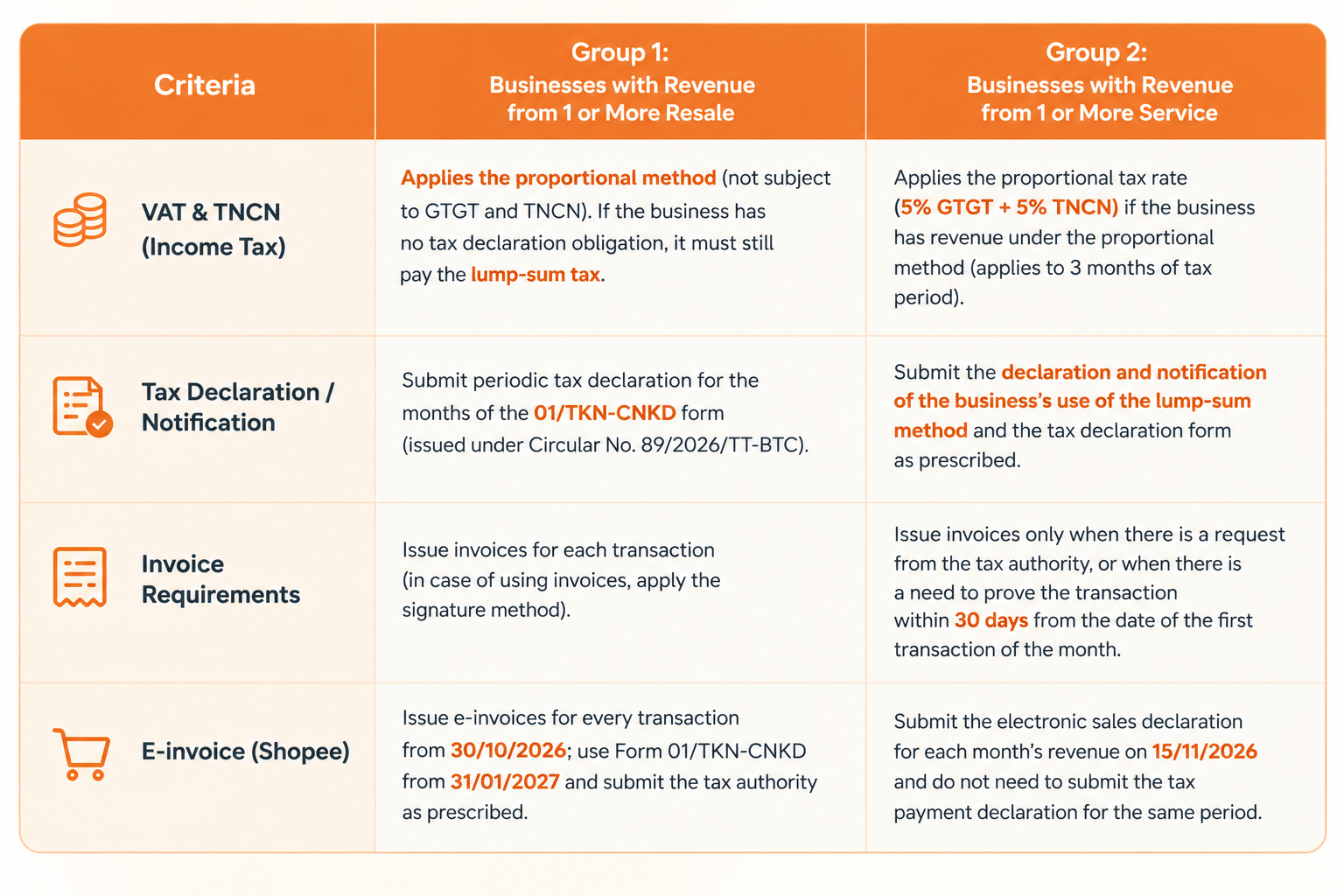
3. Deadlines for Submitting the Revenue Notification (Form 01/TKN-CNKD) in 2026
Many low-earning affiliates (making a few hundred thousand to tens of millions of VND per year) mistakenly assume that earning below the VND 1 billion threshold exempts them from all tax procedures. However, according to tax authority guidelines and Circular No. 89/2026/TT-BTC, individuals with business income under VND 1 billion must still submit an Actual Revenue Notification using Form No. 01/TKN-CNKD according to the following deadlines:
-
Individuals who operated businesses prior to 2026: Report actual revenue generated throughout 2026 no later than January 31, 2027.
-
Individuals who started business operations in the first half (H1) of 2026:
-
Report actual revenue from the start date through June 30, 2026: No later than July 31, 2026.
-
Report actual revenue generated in the second half (H2) of 2026: No later than January 31, 2027.
-
-
Individuals who started business operations in the second half (H2) of 2026: Report actual revenue from the start date through the end of 2026 no later than January 31, 2027.
4. Four Crucial Takeaways for KOLs, KOCs, and Publishers to Avoid Tax Risks
To operate affiliate channels sustainably in 2026–2027—as tax data, citizen IDs, and bank accounts are now fully integrated—affiliates must proactively adhere to these four principles:
-
Aggregate revenue from all business sources: The VND 1 billion/year threshold is not calculated separately per platform; it encompasses total annual business revenue across all sources (including commissions from Shopee, TikTok Shop, Lazada, affiliate networks, direct e-commerce sales, and direct brand sponsorship/booking fees).
-
Separate documentation before and after October 1, 2026: For commissions received during the first nine months of 2026 that had 10% withheld under the salaries and wages category, keep all tax withholding certificates for annual tax finalization or refund claims, avoiding duplicate declarations with business revenue from October 2026 onward.
-
Do not use personal family expense accounts to receive commissions: Maintain a dedicated bank account exclusively for affiliate commissions and brand booking payouts, and archive monthly bank statements for reconciliation.
-
Comply with advertising laws and product origin regulations: Alongside tax obligations, under the Law on E-Commerce 2025 and the Law on Advertising, affiliate marketers bear joint legal liability if they promote counterfeit goods, products of unclear origin, or exaggerate product efficacy (especially for cosmetics, health supplements, and pharmaceuticals).
RBox - A Leading Prestigious HR Service Provider in Vietnam & Asia-Pacific
Contact RBox today for tailored HR Solution Consulting
Hotline: 0938 051 663 | Email: sales@rbox.com.vn | Zalo OA: RBox National Jobs | LinkedIn: RBox - Recruitment in a Box