Author: RBox | Category: Human Resources Strategies and Solutions
In the booming digital era, Artificial Intelligence (AI) is no longer a futuristic tale but a present pressure in Vietnamese workplaces. Recently, the issue of "AI risks to administrative and office personnel" has taken center stage, placing businesses at a crossroads: Restructure the organization or accept a natural wave of displacement?
.png)
1. The AI Storm and the Threat of Displacement for Administrative Staff
According to recent in-depth labor market analyses, administrative and office personnel (Admins, basic HR, junior accountants) are bearing the most direct and severe impact from AI.
Practical data indicates that repetitive, rule-based, or data-entry tasks are gradually being entirely replaced by machines. Current AI tools can automate up to 60% - 70% of manual workloads, from drafting documents and tracking attendance to extracting data. This leads to an inevitable consequence: a bulky administrative apparatus with dozens of employees is no longer a measure of corporate scale, but rather a burden on operational costs.
This wave is not merely about "job stealing" but acts as a lever forcing Vietnamese enterprises to rethink their organizational structures. Maintaining a team just to perform tasks that software can handle in seconds not only shrinks profit margins but also drags down competitive speed.
2. Restructuring: From Downsizing to Specialization
Faced with the survival puzzle, "restructuring" is no longer just a slogan but a mandatory action. Instead of mechanically cutting staff and causing internal instability, many managers are choosing to restructure workflows:
-
Eliminating secondary tasks: Maximizing the elimination or digitization of internal manual work.
-
Focusing on core values: Shifting internal HR resources to strategic tasks such as building corporate culture, talent training, and performance evaluation.
-
Utilizing outsourcing services: Delegating repetitive, high-precision tasks (like payroll, tax declaration, and insurance) to specialized external agencies.
This very shift has paved the way for the trend of applying external HR solutions, most notably in salary management and disbursement.
3. Payroll Outsourcing: The Operational Solution in the Lean Era
Salary management and disbursement is the clearest evidence of an operation that "consumes vast resources but generates no direct profit." To solve the restructuring puzzle without affecting employee rights, Payroll Outsourcing is highly evaluated by experts as one of the most optimal solutions today.
3.1. What exactly is Payroll Outsourcing?
Payroll Outsourcing is a model where a business delegates its entire payroll process to an external professional agency. This operation includes calculating wages, processing complex deductions (Personal Income Tax, Social Insurance, Health Insurance, Unemployment Insurance), executing bank transfers, and issuing reports.
Currently in the market, standard service providers like RBox are applying smart software combined with a team of HR experts. This ensures that hundreds or thousands of employees receive their exact pay, on time, and in strict compliance with legal regulations.
3.2. Strategic Benefits of Choosing Payroll Outsourcing
Delegating this category brings measurable value in real numbers:
-
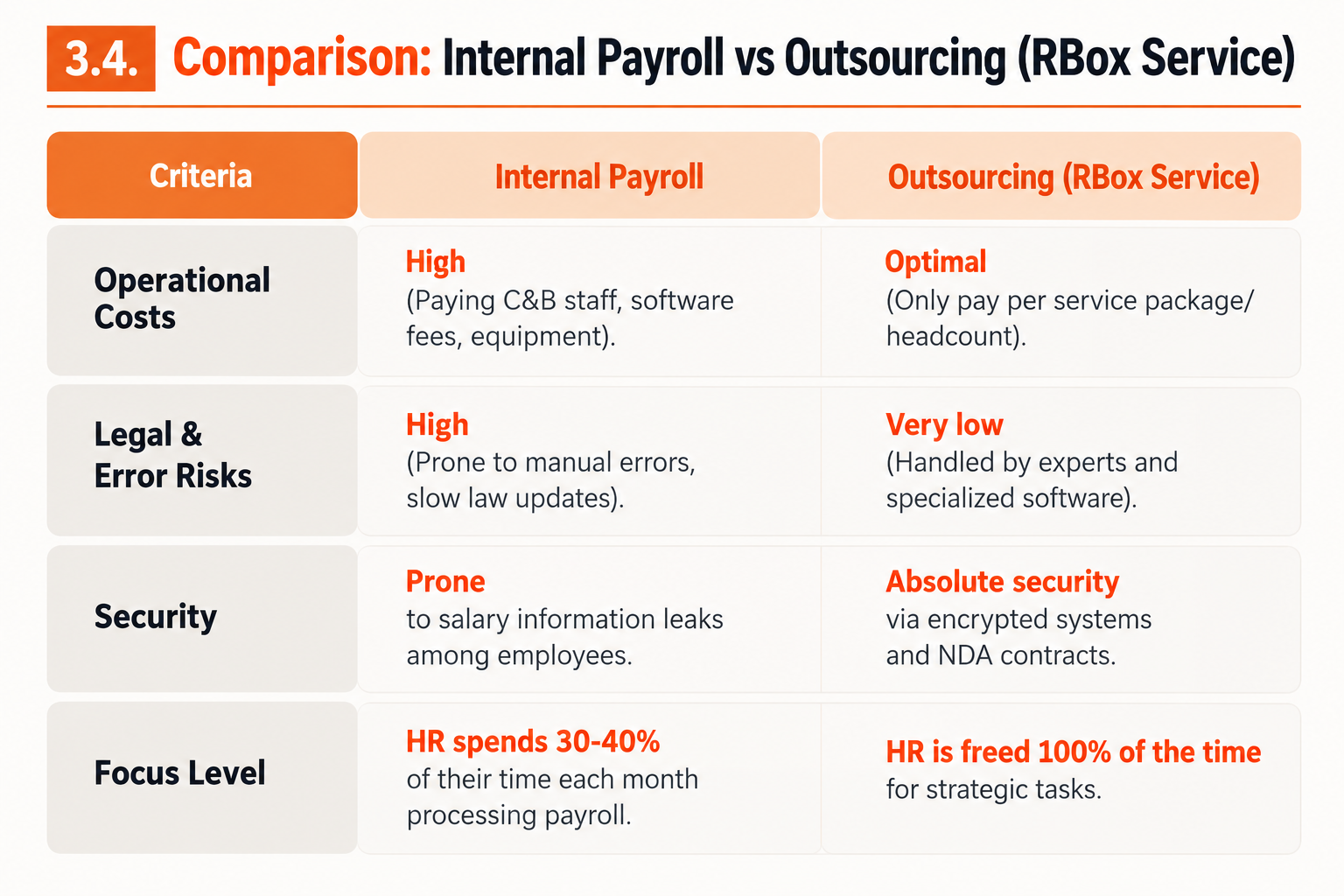
Reducing operational time and costs: Businesses do not need to maintain a massive internal C&B (Compensation & Benefits) team, nor do they incur costs for purchasing or maintaining payroll software.
-
Ensuring accuracy and legal compliance: With experts continuously updating Labor and Tax laws, the risk of errors and administrative penalties is minimized to the lowest level (virtually 0%).
-
Absolute data security: Outsourcing eliminates the "leakage" of salary information internally. Entities like RBox apply modern data security standards, ensuring transparency while maintaining complete privacy.
-
Flexible customization: Regardless of complex salary structures (base salary, KPIs, commissions, seasonal pay), outsourced systems can establish customized automation formulas for each business.
-
Liberating resources: The internal HR department is "untied" from giant Excel spreadsheets, allowing them to fully concentrate on talent retention strategies and business development.
3.3. Standards of a Professional Payroll Process
A reputable outsourcing service does not stop at "paying on your behalf"; it is a strict risk control process. At professional agencies like RBox, this process is standardized through 6 closed steps:
-
Receiving requirements: Gathering scale, salary structure, and SLA commitments.
-
Contract signing: Agreeing on scope, costs, and security KPIs.
-
Setup & Screening: Standardizing data into the system, configuring salary and tax formulas.
-
Payroll Calculation & Reconciliation: Calculating net income based on timesheet data and submitting it for corporate approval.
-
Disbursement & Handover: Executing mass bank transfers, issuing individual payslips, and handing over transaction reports.
-
Customer Care & Warranty: Handling employee inquiries and providing periodic tax/insurance reports.
3.4. Comparison: Internal Operations vs. Outsourcing Services
|
|
4. Conclusion
The advancement of AI is reshaping the labor market, making leanness a vital imperative. Instead of fearing the wave of displacement, proactively restructuring and leveraging professional services like Payroll Outsourcing is a wise move.
As a strategic partner, solutions from RBOX go beyond simply solving the payroll puzzle; they elevate management and build a robust HR apparatus. When the administrative burden is lifted, businesses will have the momentum to break all limits and focus on conquering outstanding growth targets in the new era.
RBox - A Leading Prestigious HR Service Provider in Vietnam & Asia-Pacific
Contact RBox today for tailored HR Solution Consulting
Hotline: 0938 051 663 | Email: sales@rbox.com.vn | Zalo OA: RBox National Jobs | LinkedIn: RBox - Recruitment in a Box